Daily reflection
Friday September 18th, 2026: Make fairness practical
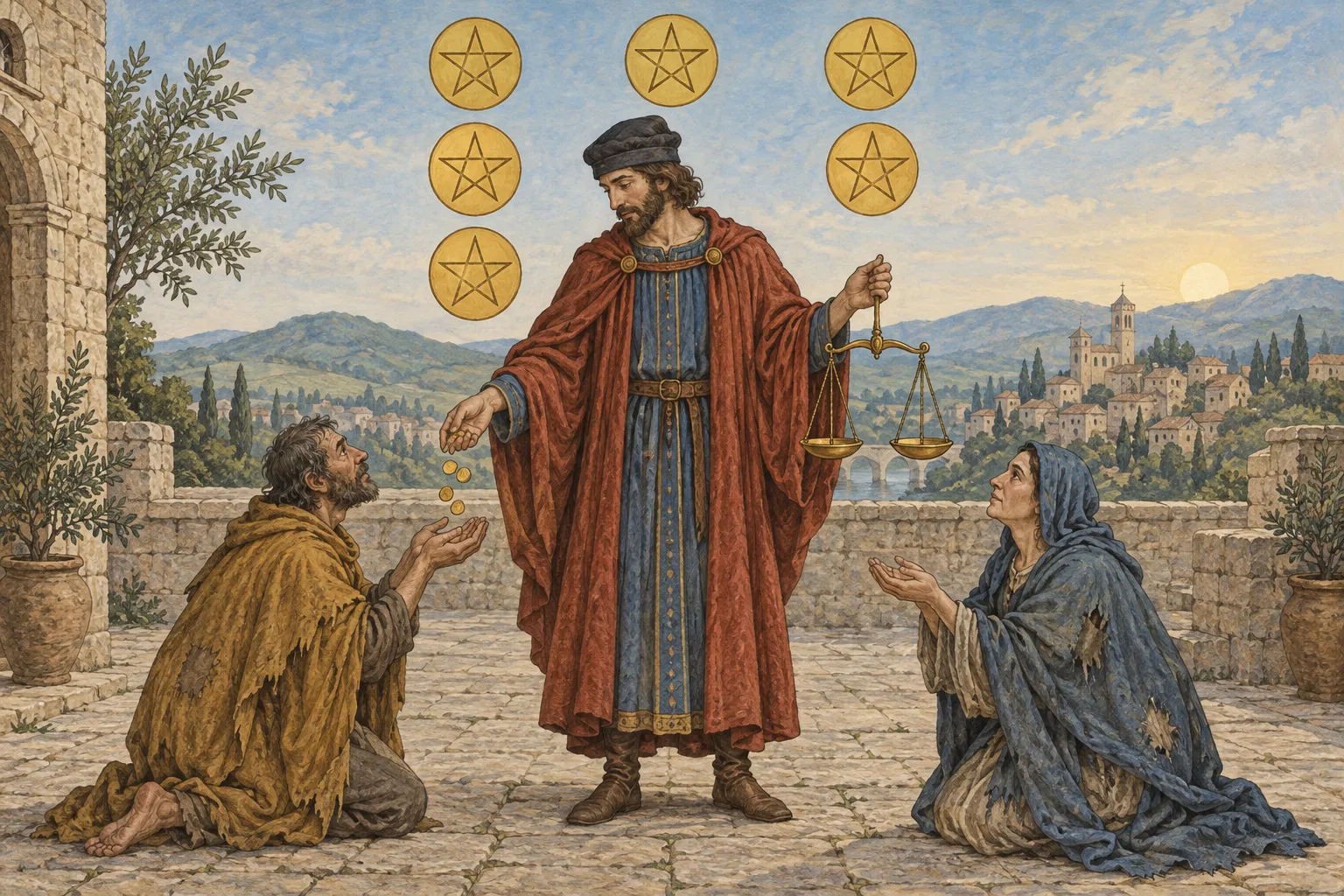
Cover accessibility description Visible scene A landscape illustration shows a bearded merchant in a red cloak, blue striped tunic and dark cap standing on a stone terrace. His right hand, at the viewer's left, drops small gold coins towards a kneeling man's open hands. The man wears a worn ochre cloak. The merchant's left hand holds a gold balance with two hanging pans at the viewer's right. A second adult in a patched blue hooded cloak kneels on that side with open hands. Six large gold discs containing five-pointed stars hang in the sky: three across the top, two in the next row at left and right, and one further down at left. The small falling coins have no stars. A low wall frames distant green hills, a river bridge and a town with a church tower. The low sun glows on the right. A stone arch and a potted leafy tree appear at the left edge. The palette is muted red, ochre, blue and warm stone. All three figures and the essential symbols remain within the image. No lettering, label, signature or watermark is visible. Symbolic interpretation The arrangement recalls Six of Pentacles, the first card of the unchanged approved spread. The giver's scales and the recipients' open hands support reflection on the terms of help and practical fairness. This is an editorial interpretation, not a prediction or a judgment of anyone's worth. Provenance and display AI-generated original editorial illustration, not a historical card scan. Keep the full 3:2 composition so the six discs, recipients and scales remain visible. Original PNG and generation provenance are stored separately.
By Friday, a generous yes can have a sharp little edge. You agreed to help, and now you are hoping somebody will notice what it costs. Today’s deliberately chosen spread asks how generosity becomes fair, workable cooperation. The cards offer questions for reflection, not predictions or a verdict on anybody’s character.
Six of Pentacles
In the Rider–Waite–Smith tradition, Six of Pentacles shows a merchant holding scales and distributing money to people in need. Waite describes gifts, prosperity and goodness of heart. Yet the picture also invites an uncomfortable observation: the giver holds both the resources and the instrument of measurement. Good intentions do not automatically tell us whether the person receiving help has much say in its terms.
Perhaps you offer detailed advice when someone needs a lift, or volunteer to reorganise work that they wanted help finishing. It can feel generous from your side and exhausting from theirs. Before deciding what to give, ask what would actually help. If the answer is beyond your means, it is still useful information. You can acknowledge a need without appointing yourself responsible for meeting all of it.
For a Stoic starting point, consider Epictetus’s Enchiridion, section 1, in Elizabeth Carter’s translation. In paraphrase: our own judgments and actions belong to us in a way that property, position and reputation do not. Applied here, that distinction shifts attention from possessing the resources of a benefactor to using available resources responsibly. It does not imply that material deprivation is unimportant, deserved or curable by attitude.
Make one offer specific enough to decline freely: collecting groceries on Saturday, reviewing a page, taking one part of a shared task. Ask before spending somebody else’s time on your solution. If you need help yourself, name the need as clearly as you can; needing assistance is no failure of character. The scales of Six of Pentacles are an invitation to examine the arrangement, not weigh the worth of the people involved.
Queen of Swords
Queen of Swords holds her blade vertically and extends her other hand. In Waite’s older account, her expression suggests familiarity with sorrow, and the meanings include mourning and separation. We should not flatten that history into a cheerful slogan about boundaries. For this reflection, her sober bearing suggests judgment informed by experience: the knowledge that an arrangement can hurt even when nobody intended it to.
Think of the last favour that left you resentful. Had you agreed to the whole task, or only imagined that your limit was obvious? Perhaps the request was genuinely unreasonable; perhaps it expanded unnoticed. Clarity begins by finding out which. The extended hand gives our reading an important counterweight to the blade: a limit can invite a more honest conversation rather than simply ending one.
Epictetus’s distinction in section 1 also places reputation outside our own actions. My application is this: you can explain a reasonable limit carefully, but cannot ensure that everybody calls you kind. That does not make their response irrelevant. They may point out a commitment you forgot or an unfair burden you have missed. Listen for information without treating either approval or displeasure as the final measure of your conduct.
Before replying, put the available time beside the requested task. If you can read one page but not rewrite the report, say exactly that. Avoid padding the limit with so many apologies that it sounds negotiable when it is not. Where refusal could carry consequences, especially at work, consider support and a documented request to change priorities. Queen of Swords asks for discernment, not a performance of fearlessness from someone with little power.
Three of Pentacles
Three of Pentacles brings us to skilled work: Waite describes a sculptor working in a monastery and names trade and craftsmanship among its meanings. A building asks more of us than a generous impulse or a well-phrased refusal. Something has to fit, bear weight and remain useful after the conversation ends. In today’s reading, that makes the card a practical test of the agreement taking shape.
The scales asked what help was useful; the upright sword helped establish its limits. Now give the work enough definition to proceed. Who will do what, by when, and with which information? If you offer to review the page, agree whether that means checking facts, improving sentences or deciding the whole argument. Shared words such as help and finished can conceal surprisingly different expectations.
The Stoic connection is the movement from a principle we admire to an action somebody can rely on. This is our practical extension of section 1, rather than a separate ancient quotation about teamwork. Neither an impressive offer nor a spotless reputation completes the task. A modest agreement kept with care may serve another person better than an expansive promise made while hoping the workload will somehow shrink.
Before the week closes, confirm one arrangement in a short message and invite correction. Include the less visible work: arranging access, gathering materials, following up, clearing away. If the same person repeatedly absorbs those jobs, propose an actual redistribution rather than thanking them more warmly. Three of Pentacles leaves us with fairness that can be inspected: not identical contributions, necessarily, but contributions discussed honestly, supported adequately and open to revision.
Journaling prompt
Where have I offered more than I can give, or chosen help without asking what was needed? Write one smaller offer and one clear request of your own. What agreement would leave both people better informed, including whoever usually carries the work nobody names?