Daily reflection
Saturday September 19th, 2026: Rest without earning it first
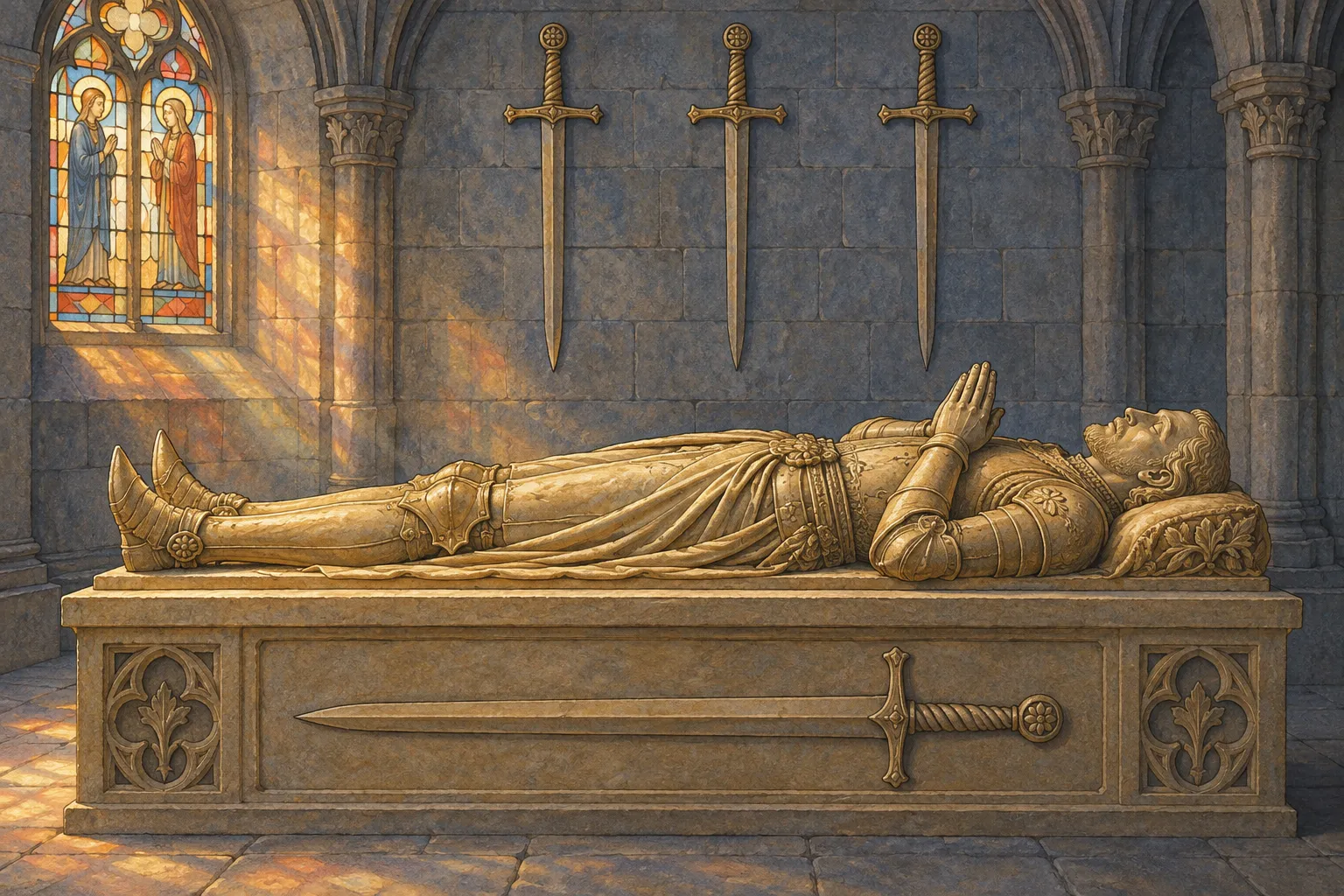
Cover accessibility description Visible scene A golden carved effigy of an armoured knight lies on a rectangular stone tomb in a blue-grey chapel. His head rests on a carved cushion at the right and both pointed feet extend to the left. His eyes are closed and his hands meet in prayer above his chest. Three complete golden swords hang vertically on the wall, their points down. A fourth complete sword lies horizontally across the tomb front, point left and hilt right. A stained-glass window at upper left shows two robed figures; amber light falls across the wall and tiled floor. Stone columns and arches frame the scene. No writing, label, signature or watermark is visible. Symbolic interpretation The arrangement recalls Four of Swords, first in the unchanged approved spread. Stillness and the sheltered chapel support reflection on rest without requiring recovery to prove its worth. This is an editorial interpretation, not a prediction or a medical claim. Provenance and display An AI-generated original editorial illustration, not a historical scan. Preserve its full 3:2 composition so all four swords, the complete effigy and the window remain visible.
Saturday morning, and already the free hours have acquired a job description: recover efficiently, enjoy yourself properly, emerge improved. Today’s deliberately chosen spread offers another possibility. These cards are prompts for reflection, not predictions. We can put something down, notice what is here, and leave the outcome of resting ungraded.
Four of Swords
The still figure in the Rider–Waite–Smith Four of Swords is a knight’s effigy lying on a tomb, hands held in prayer. This is more solemn than a picture of someone taking a nap. A. E. Waite includes retreat, solitude and repose among its meanings. We need not turn the tomb into an omen; its stillness can interrupt our assumption that every available moment must be filled.
There is often a little negotiation before we allow ourselves to stop. One more email, then the chair by the window. The washing up, then the book. Occasionally these are necessary arrangements; occasionally the finish line moves whenever we approach it. The card invites us to notice the difference. An unfinished household is not, by itself, evidence that its inhabitants have forfeited the afternoon.
In paraphrase, Epictetus’s Enchiridion, section 1, translated by Elizabeth Carter, distinguishes our own actions and judgments from such things as property, reputation and the body. Applied here, this is a distinction between making a reasonable space for rest and commanding its effects. It is not an ancient prescription for a weekend routine. Nor does it mean that illness or exhaustion can be corrected by choosing a better attitude.
Choose one interval in which the recurring problem will not receive your attention. If someone reasonably expects an answer, tell them when you will return. Then stop without creating a second task called resting well. You may feel restless; the first quiet minutes can be noisy inside. If caring duties or insecure work leave little room, a request for practical cover may matter more than any private exercise.
Nine of Pentacles
In the Nine of Pentacles, a woman stands among abundant grapevines, a bird resting on her wrist. Waite describes the garden of a manorial house and the suggestion of material well-being. Prudence, safety and accomplishment belong to his listed meanings. This is a cultivated place, not an empty wilderness: there are things here that someone has tended, and now there is time to stand among them.
Following the withdrawal of the Four of Swords, this card asks what we might actually enjoy. Not what would look like an enviable Saturday, but what gives this particular person pleasure. The comfortable old jumper may beat the expensive outing. A familiar album may be preferable to a podcast promising to transform your habits. You need not turn either preference into a statement about your identity.
There is a useful check on the garden’s splendour in Enchiridion, section 44, Carter translation. In paraphrase, Epictetus rejects the inference that having more wealth makes someone a better person. The garden therefore supplies no moral ranking. Financial security can make rest more accessible, and its absence creates real strain. Enjoying a small comfort does not require pretending that a cup of tea compensates for inadequate housing or impossible hours.
Use something you already like without saving it for an imaginary better occasion. Take the good cup from the back of the cupboard; open the book without promising to finish it. If pleasure arrives, let it be particular: the warmth through the ceramic, a sentence worth reading twice. If it does not, there is no gratitude test to fail. You are making an invitation, not submitting evidence of contentment.
The Star
Under a great eight-rayed star and seven smaller stars, the figure in The Star pours water from two vessels, tending both water and land. Waite calls it the Water of Life; hope is a familiar association of the card, although his account reaches into more elaborate spiritual symbolism. For this reading, the poured water suggests nourishment offered without a visible deadline for its results.
That matters when rest has begun to feel like a transaction. We give it an afternoon and expect clear skin, a quiet mind and a splendid Monday in return. The Star offers no such bargain. Alongside the protected pause and the garden’s ordinary pleasures, it leaves room for a future that is not yet settled. Hope need not mean feeling confident; sometimes it means not treating today’s depletion as a permanent forecast.
Return to the distinction in Enchiridion, section 1: the body is not entirely ours to command. We can attend to its needs without issuing orders about how quickly it must respond. Persistent or worrying fatigue deserves appropriate support, not a philosophical rebuke. This is reflective practice, not medical advice, and needing care from other people is no failure of self-sufficiency. A quiet day can be worthwhile even when it is not enough.
Let tonight end without a score for recovery. Notice whether there is something specific to ask for: help with tomorrow’s meal, a conversation, an appointment, another protected interval. Make that request if you can. Otherwise, allow the book to close on an unfinished chapter. The day has contained a human being, not a repair project, and you do not owe tomorrow proof that every hour was well spent.
Journaling prompt
What did I ask rest to prove today? Describe one comfort without explaining how it made you more productive. What need remains, and what kind of help or space would take it seriously?