Daily reflection
Wednesday September 16th, 2026: Practise without applause
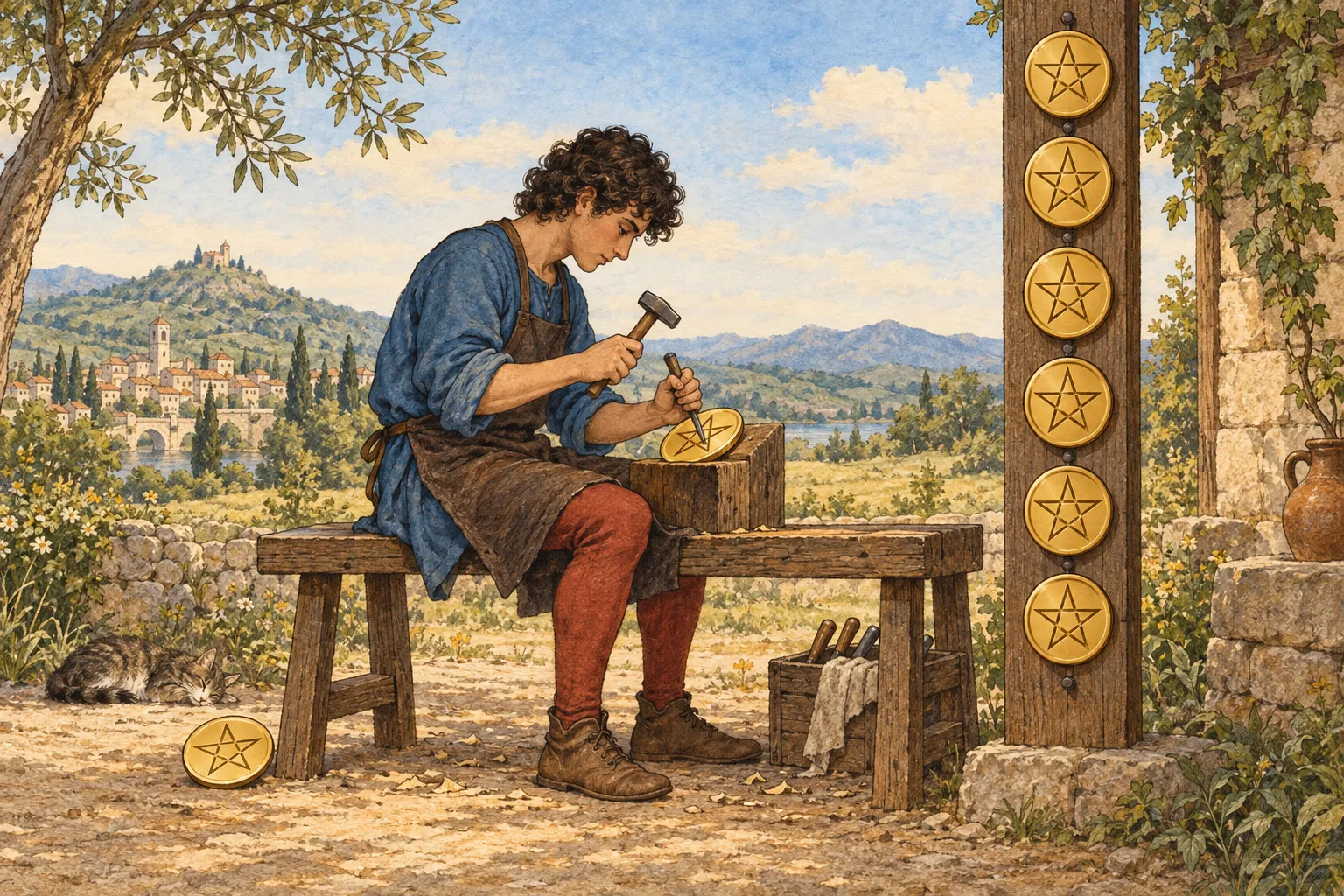
Cover accessibility description Visible scene A landscape ink-and-watercolour-style illustration shows a curly-haired craftsperson sitting on a wooden bench, facing right and bending towards a golden disc on a wooden block. The person wears a blue tunic, brown apron, rust-red trousers and brown boots. One hand holds a small hammer and the other grips a chisel against the disc. Six separate golden discs hang in a vertical column on a wooden post at the right. Another disc lies on the ground at the left of the bench, making eight altogether. Each disc bears a five-pointed star. A leafy tree, small white flowers and a low stone wall frame the left foreground. A distant town, green hills and a strip of blue water sit beneath a lightly clouded sky. At the right is an ivy-covered stone wall and a clay jug. A box of tools and a pale cloth rest under the bench. Both boots, the working hands, tools and all eight discs are visible. There are no words, numbers, labels or signatures. Symbolic interpretation The composition recalls Eight of Pentacles, the first card of the reading's preserved, deliberately selected spread. Attentive manual work and the displayed pieces support the reading's theme of practice without applause. This is an editorial interpretation, not a prediction or evidence that diligent work guarantees success. Provenance and display This is a newly AI-generated illustration, not a historical tarot scan. Generation and visual-review evidence are stored separately in the cover sidecar and request/receipt files. The original PNG is preserved. The JPEG derivative retains the complete landscape composition without cropping. Its native aspect ratio is 3:2; future article, homepage and social integration must preserve every disc and the worker's tools rather than apply an unchecked banner crop. Integration and rendered accessibility have not yet been validated.
By Wednesday, the work begun on Monday may still look ordinary. The page is better, perhaps, but nobody has mentioned it. Today’s deliberately selected spread, not a random draw, explores that quiet middle: practising a skill, assessing the return and receiving recognition without depending on it. These images promise no success. They help us ask what would make another day’s effort worthwhile.
Eight of Pentacles
The Eight of Pentacles shows a craftsperson bent over a pentacle, tools in hand, with completed pieces displayed nearby. A town stands in the distance; the immediate scene belongs to the bench and the work upon it. There is repetition here, but also close attention. The next piece has not become unnecessary simply because several others have already been made.
Work, employment, craftsmanship and skill are among the meanings Waite gives this card, including the possibility of a preparatory stage. Eight of Pentacles allows room for learning before mastery. That matters when an awkward attempt feels embarrassing. A beginner’s effort is not a defective version of an expert’s identity. It is work at a particular stage, with particular mistakes that can be examined and, sometimes, corrected.
Epictetus treats philosophy as something shown in conduct rather than advertised. Paraphrasing the Enchiridion, section 46, in Elizabeth Carter’s translation: demonstrate what you have learned through the actions it produces, rather than through speeches about your learning. The connection to craft is our own analogy. Knowing the vocabulary of clear writing does not yet produce a clear paragraph; the understanding becomes useful when a reader can follow what you mean.
Choose one small technique and give it twenty minutes, or a shorter interval that your circumstances permit. Revise an unclear instruction, practise a difficult musical passage slowly or rehearse one part of a presentation. Keep the first attempt and compare it with the next. Ask a specific question about the difference. You are looking for something you can learn from, not collecting proof that you are finally a talented person.
Seven of Pentacles
In the Seven of Pentacles, a worker leans on a long-handled tool and studies the pentacles gathered in the greenery before him. Unlike the craftsperson at the bench, he has stopped moving. His attention rests on what has grown. The image contains labour and a pause within the same scene; standing back to inspect the result is not necessarily the opposite of working.
Patience, investment and assessment are familiar contemporary readings. Waite’s older account is more unsettled: he describes the figure’s intent gaze, then lists money, business and barter among meanings he acknowledges are contradictory. We should not make Seven of Pentacles promise an inevitable harvest. For this reading, the pause in the picture invites a practical assessment of whether effort is producing a worthwhile return, and what it is costing.
There is a useful counterweight to blind persistence in Epictetus. Paraphrasing Enchiridion, section 29: consider what an undertaking requires and what may follow before committing yourself; even a trained competitor can lose. Our application is to review effort without assuming that dedication guarantees results. Money, health, time and access to instruction affect what is possible. A disappointing outcome does not, by itself, establish a lack of character or care.
Set a review date suited to the task, and decide what evidence you will bring to it. After several practice sessions, can someone follow the instruction more easily? Is the difficult passage more consistent? Record the method as well as the result. If the cost is already unaffordable or the approach is causing harm, do not wait merely to prove patience. Otherwise, allow a fair trial before deciding whether to continue, adjust or stop.
Six of Wands
The Six of Wands brings us back into company. A rider wears a laurel wreath and carries a staff crowned with another, while people bearing staves accompany him. It is a public scene after the private bench and the watchful garden. The visible signs of achievement are unmistakable, but they belong to a procession: other people are present, and recognition is being shared in their sight.
Victory, good news and acknowledged achievement are traditional meanings; Waite explicitly describes a victor triumphing. Six of Wands need not become a warning against enjoying praise. Encouragement can sustain difficult work, and public credit can have practical consequences. The invitation is to receive recognition honestly without asking it to settle every question about the quality of your work, much less your worth as a person.
Here Monday’s distinction returns in another form. Paraphrasing Enchiridion, section 1: reputation is not among the things that are our own actions. You can present your work accurately and ask for feedback; you cannot command another person’s esteem. This is not a reason to accept stolen credit or unfair treatment. It is a reason to pursue fair recognition without making someone else’s response the sole measure of whether your effort mattered.
If praise comes, thank the person and name anyone whose contribution helped. If it does not, review the work against the standard you chose at the bench. Seek one useful piece of feedback rather than repeatedly checking for reactions. Where credit affects pay or opportunity, keep a factual record of your contribution and raise the issue through an appropriate channel. Quiet practice and fair advocacy can belong to the same day.
Journaling prompt
What did I practise, and what changed between attempts? What evidence will I use at my review date? Name one part of today’s work that remains valuable without applause, and one kind of feedback or recognition I have a reasonable need to request. How can I honour both without confusing them?