Daily reflection
Tuesday September 15th, 2026: Pause before the reply
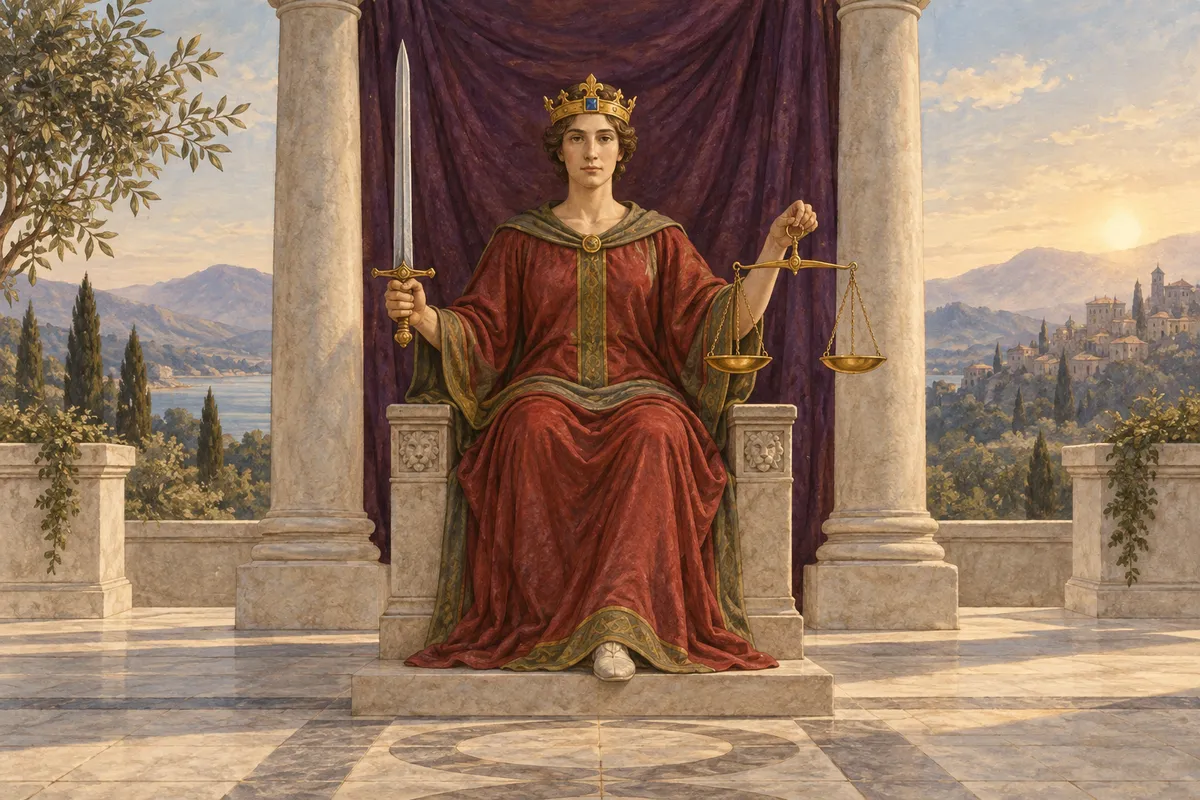
Cover description Justice faces the viewer from a carved stone throne between two pale pillars. The figure wears a gold crown with a blue jewel and a crimson robe edged in olive green. An upright sword is held on the viewer’s left; on the right, two golden scale pans hang evenly from a level beam. A purple curtain fills the space behind the throne, and one pale shoe appears below the robe. Warm sunlight falls across the stone terrace, with trees, hills, water and a distant settlement beyond. The still pose and balanced scales echo the reading’s invitation to weigh evidence before replying. The retained sword suggests that a considered response can also be firm. This symbolic interpretation is editorial, not a prediction. Original AI-generated artwork inspired by traditional Rider–Waite–Smith imagery; not a reproduction of a historical tarot card.
Yesterday’s useful intention can disappear in the time it takes to read one sharp message. A missing greeting becomes a sneer; a request becomes an accusation. For the second day of our relaunch week, these cards have been deliberately selected, not randomly drawn. They offer a way to examine a reply before sending it, not a way to discover someone else’s hidden motives.
Justice
Justice sits between two pillars, with scales in one hand and a sword held upright in the other. The figure faces us directly. In the Rider–Waite–Smith image, weighing and deciding belong together: the scales receive attention, but the sword has not been discarded. This is not a picture of endless hesitation. It gives discernment a place before the decisive act.
Fairness, accountability and judgment are central to the card’s traditional meaning. Waite associates it with the moral principle of dealing with people according to their works. We need not turn that symbolism into a claim that everyone gets what they deserve; plainly, people suffer injustice. Here, Justice is a standard for our own response: consider what happened, who was affected and what a proportionate answer would require.
Epictetus offers a useful discipline of description. Paraphrasing the Enchiridion, section 45, in Elizabeth Carter’s translation: describe an observed action without hastily adding a judgment about why it was done. A brief message is brief; contempt is an interpretation that needs evidence. This does not oblige you to ignore a pattern of mistreatment. A history of repeated insults is evidence too, and deserves a place on the scales.
Copy the sentence troubling you onto a page. Beneath it, record your interpretation, then the relevant context: an agreed deadline, earlier exchanges, any missing information. Ask what could change your reading. If the message asks whether something is finished, answer that question before defending yourself against an accusation it may not contain. If it contains an explicit insult, name the behaviour accurately rather than explaining it away.
Knight of Swords
The Knight of Swords rides at full speed, his sword raised, while wind drives through the surrounding scene. Horse and rider are committed to their direction; there is little suggestion of an easy stop. The image captures the bodily feeling of an urgent reply remarkably well: shoulders forward, attention narrowed, fingers already assembling the sentence that will settle everything.
The traditional meanings are not simply a warning against haste. Waite includes skill, bravery and defence alongside wrath, conflict and opposition. The card’s energy can protect someone or cut through evasion. Knight of Swords becomes troublesome when the force of conviction outruns the facts. The relevant question is not whether you should ever speak quickly or firmly, but whether speed is serving the situation or merely discharging your discomfort.
A useful part of Enchiridion, section 20, can be paraphrased this way: gaining time and respite helps us avoid being swept along by an impression. We can use that advice without adopting the passage’s stronger claim that provocation resides in our judgment. Threats and harassment cause real harm. A pause is a tool for choosing a response, never a reason to postpone urgent protection or assistance.
For a non-urgent message, draft in a separate note so there is no send button within reach. Remove claims about motives that you cannot support. Replace one sweeping accusation with a factual question, if a question could genuinely help. Then leave the draft while you get water or step outside. On returning, read it for its likely effect: will the recipient understand the issue and the next step, or only your anger?
Strength
In Strength, a woman places her hands at a lion’s jaws without brandishing a weapon. Flowers form a garland, and the infinity sign appears above her head. Waite describes the lion as already subdued by her fortitude. The contrast with the charging rider is striking: here, power is expressed through composure and contact rather than a gathering of speed.
Courage, fortitude and mastery of the passions are established associations of this card. That is richer than simply being nice. Strength asks what it takes to remain purposeful when another person’s conduct stirs fear or fury. The image need not make an enemy of emotion; anger may alert you to a crossed boundary. The task is to decide what that information calls for, rather than letting the hottest feeling write the whole reply.
The Stoic connection is a practice of proportion. Paraphrasing Enchiridion, section 10: meet a circumstance by considering which capacity might help you respond, including patience when confronted with unpleasant speech. Our application must also leave room for support and safety. Patience does not require continued access to you. Sometimes courage means ending an exchange, documenting what happened or asking someone trustworthy to stand beside you.
Write a reply with a clear fact, a limit and an available next step. You might explain that you can discuss the work tomorrow, but will not continue a conversation containing personal insults. Keep the limit within what you can actually do. You cannot guarantee an apology or a reasonable answer. You can make your position understandable, follow through where possible and seek help if enforcing it would put you at risk.
Journaling prompt
What did the message actually say, and what did I add? What evidence supports my reading? Draft one question that would clarify the issue and one boundary that would protect something important. Choose what fits the facts. If no reply is safe or useful, what support or practical action would serve you better?